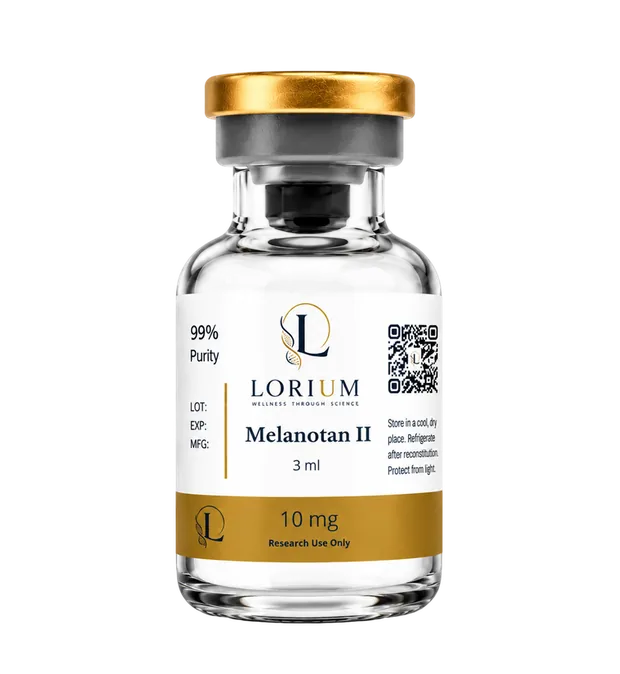
 LORIUM · 5 mg LYOPHILISED VIAL
Melanotan II
Melanotan II is an advanced cyclic α-MSH analogue engineered as a non-selective melanocortin receptor agonist to drive both structural and metabolic rejuvenation. By crossing the blood-brain barrier to target hypothalamic centers while simultaneously activating dermal receptors, this dual-action protocol uniquely stimulates natural skin pigmentation alongside robust metabolic and libido optimization.
Researched effects
Effects observed in the cited literature. Individual results are not guaranteed. Statements have not been evaluated by the FDA.
Accelerated Deep Tanning
Promotes rapid, uniform skin darkening with minimal to zero UV exposure.
Advanced Appetite Suppression
Effectively modulates hypothalamic signaling to reduce caloric intake.
Optimized Body Composition
Supports accelerated fat loss while fully preserving lean muscle mass.
Dermal Melanogenesis
Activates MC1R to promote deep tanning without UV exposure.
Targeted Erectile Support
Studied to show structural efficacy in inducing performance erections.
Amplified Baseline Libido
Powerfully boosts intrinsic sexual desire and arousal in men and women.
Glycemic Equilibrium
Improves systemic glucose metabolism and cellular insulin sensitivity.
Specifications
Clinical references
- Dorr, R. T., et al. (1996). Evaluation of Melanotan-II for Skin Pigmentation. Life Sciences, 58(20).
- Wessells, H., et al. (1998). Effect of Melanotan II on Erectile Function. Journal of Urology, 160(2).
- Wessells, H., et al. (2000). Melanocortin Receptor Agonists and Sexual Arousal. Int J Impotence Res, 12(4).
- Strader, A. D., et al. (2007). Metabolic Influences of Central Melanocortin Activation. J Pharmacol Exp Ther, 322(3).
More in Vitality
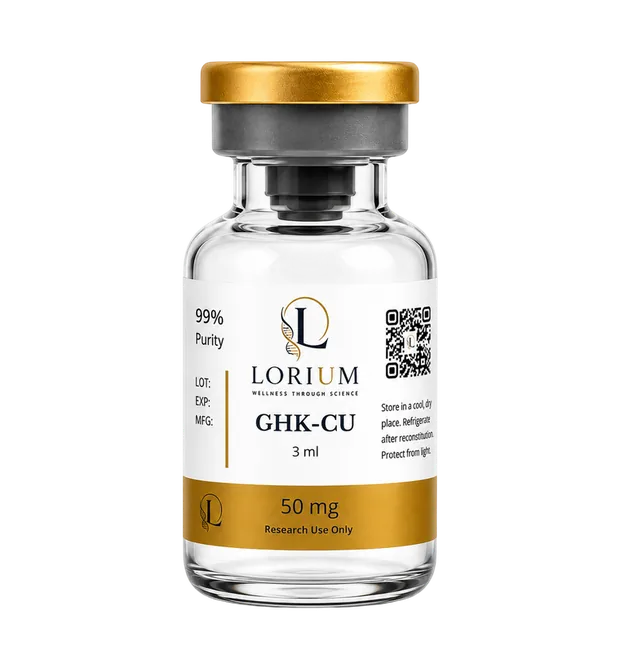
GHK-Cu
A naturally occurring plasma-derived copper complex that acts as a gene modulator to accelerate tissue remodeling, stimulate structural proteins, and repair dermal damage.
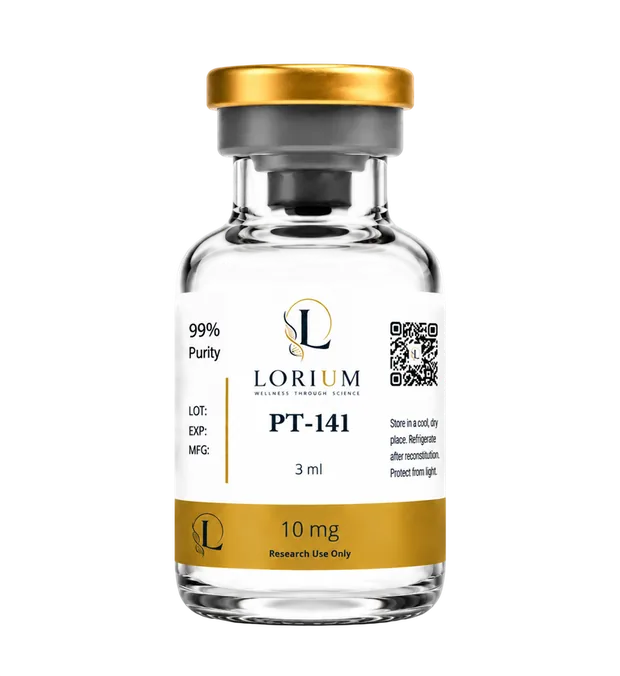
PT-141
A melanocortin receptor agonist that enhances sexual function and desire through targeted neurological pathways rather than vascular dilation.